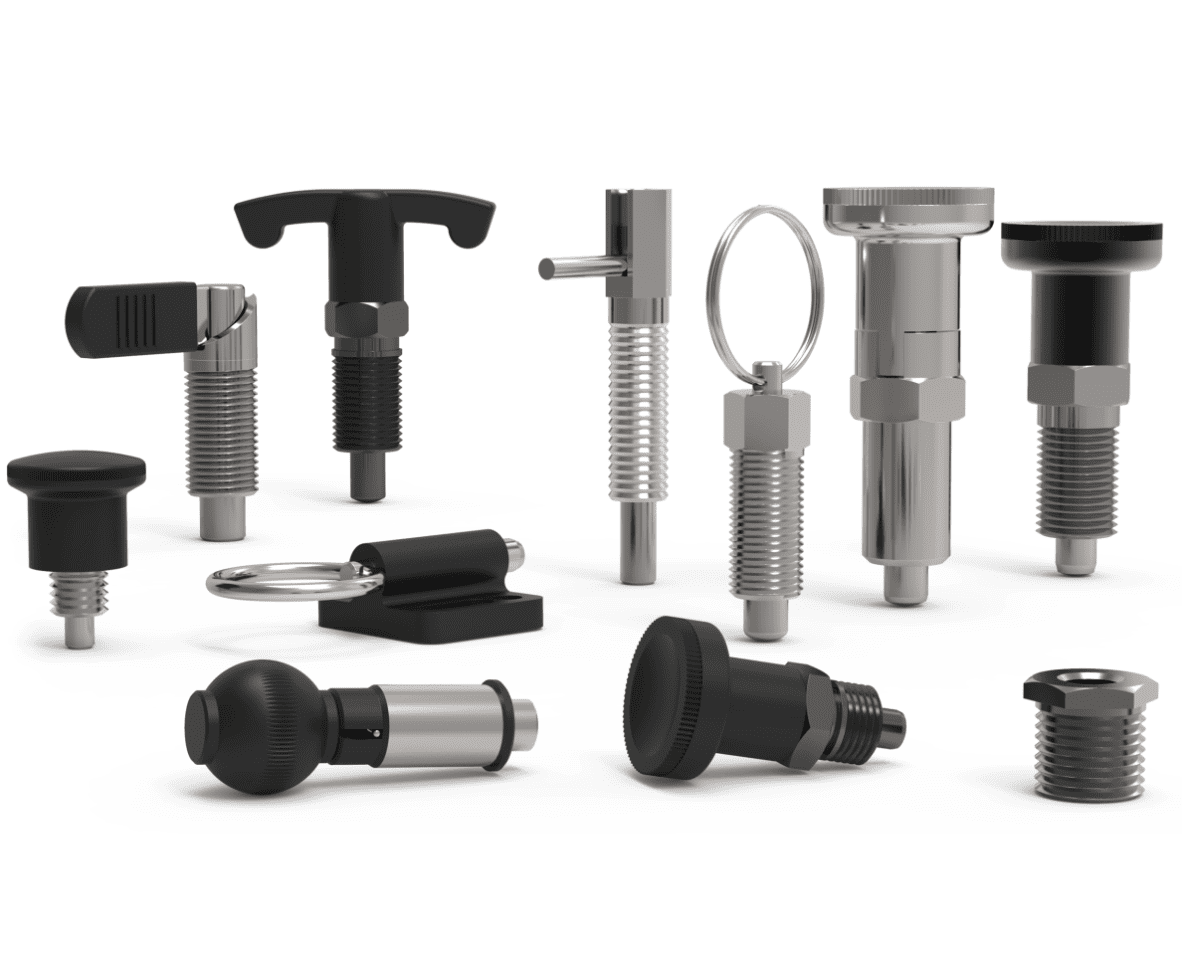
An indexing plunger is a spring-loaded mechanical device that locks components in precise positions and allows controlled movement between set locations. These simple but essential tools show up in manufacturing equipment, jigs, fixtures, and machinery where parts need to stop at exact spots. They work by using a spring-loaded pin that pops into detents or holes to hold position.
Indexing plungers let you position and hold parts accurately without needing external locks or complex mechanisms. You push the plunger down to release it, move your part to the next position, and let go so it locks into place again. This makes them perfect for repetitive tasks where you need the same positioning every time.
Understanding the different types and how to choose the right one can save you time and prevent equipment problems. The design, material, and style all affect how well an indexing plunger works for your specific needs.
Key Takeaways
- Indexing plungers are spring-loaded pins that lock parts into precise positions for accurate and repeatable placement
- Different types and materials are available to match your specific application requirements and environmental conditions
- Proper selection based on load capacity, mounting style, and operating environment ensures reliable long-term performance
Understanding Indexing Plungers
Indexing plungers use spring tension and precise pin mechanisms to lock components into specific positions. These devices consist of a plunger body, internal spring, and positioning pin that work together to create repeatable location points in machinery and equipment.
Key Components and Mechanisms
The plunger body forms the outer housing of an indexing plunger. This cylindrical component threads into your machine or fixture and holds all internal parts in place. Most plunger bodies are made from steel or stainless steel to withstand industrial environments.
Inside the body, a compression spring provides the force needed for operation. The spring pushes against the plunger pin, which is the part that extends outward to engage with detents or holes in your workpiece.
The pin itself has a specific nose style that affects how it functions. Common styles include ball nose, flat nose, and cone nose designs. Each style suits different positioning requirements and surfaces.
A locking mechanism controls whether the plunger can move freely or stays locked in position. Some indexing plungers include a pull ring or knob that lets you retract the pin manually when you need to reposition components.
How Indexing Plungers Work
When you install an indexing plunger, the spring pushes the pin outward through the body. The pin seats into a matching hole or detent in your workpiece. This creates a positive lock that holds parts in their correct position.
The spring tension determines how firmly the plunger holds. You can select different spring forces based on your application needs. Light springs work for positioning applications while heavier springs provide stronger holding force.
To release the position, you pull back on the locking element. This compresses the spring and retracts the pin from its seated position. You can then move your workpiece to a new location where the pin will snap into the next detent point.
Common Applications
Indexing plungers position rotary tables and fixtures on machine tools. The plungers lock the table at precise angles, allowing you to machine features at exact locations around a part.
Manufacturing equipment uses spring plungers to align components during assembly. The plungers ensure parts mate correctly and stay in place during welding, fastening, or bonding operations.
Adjustable fixtures and jigs rely on indexing plungers for quick position changes. You can move a fence or stop to different preset locations without measuring each time. This speeds up production and reduces setup errors.
Types and Variations of Indexing Plungers
Indexing plungers come in several designs that differ in how they operate and how you control them. The main variations include manual versus automatic operation, different internal mechanisms like spring-loaded or cam action systems, and various external grip designs.
Manual Versus Automatic Plungers
Manual indexing plungers require you to physically pull or push the plunger to disengage it from its locked position. You must hold the plunger in this position while repositioning your workpiece or equipment. Once you release it, the spring mechanism pushes the plunger back into the locked position.
Automatic plungers work differently. They disengage when you apply pressure or reach a certain position, then automatically re-engage without you having to hold them. This hands-free operation makes them useful when you need both hands for other tasks.
Manual plungers give you more control over when the plunger locks and unlocks. Automatic versions speed up repetitive positioning tasks.
Spring Loaded and Cam Action Options
Spring plungers use an internal spring that provides constant pressure to keep the plunger extended into its locked position. When you pull the knob or handle, you compress the spring against its natural force. The spring’s tension determines how firmly the plunger stays in place.
Cam action indexing plungers use a rotating cam mechanism instead of just spring pressure. You twist the knob to move the cam, which pulls the plunger pin back. This design requires less pulling force from you and can be easier to operate repeatedly.
The cam action style locks more securely because it doesn’t rely only on spring tension. Spring plungers are simpler in design and cost less.
Knob and Handle Designs
The knob is the part you grip to operate the indexing plunger. Round knobs are the most common style. They fit comfortably in your hand and work well for most applications.
T-handle designs give you more leverage when you need extra pulling force. Ball knobs provide a secure grip even with gloves on.
Some plungers feature plastic knobs while others use metal. Plastic stays cooler to touch and weighs less. Metal knobs last longer in harsh environments and withstand higher temperatures.
Design, Installation, and Materials
Indexing plungers feature specific design elements that determine how they mount, perform, and last in your application. The threaded body provides the primary attachment method, while material selection affects strength and corrosion resistance.
Threaded Body and Mounting Methods
The threaded body serves as the main mounting interface for your indexing plunger. Most plungers use standard metric or imperial thread sizes that screw directly into tapped holes in your fixture or machine component.
You’ll find two common installation approaches. Through-hole mounting lets you insert the plunger through a clearance hole and secure it with a lock nut on the opposite side. Blind-hole mounting threads the plunger directly into a tapped hole without access to the back side.
The threaded portion typically includes a hexagonal section or wrench flats. These features let you tighten the plunger body to the correct torque during installation. Some designs also include a locknut or thread-locking compound groove to prevent loosening from vibration.
Material Choices and Durability
Steel remains the most common material for indexing plungers due to its strength and wear resistance. Hardened steel versions offer increased durability for high-cycle applications where the plunger engages and releases thousands of times.
Stainless steel plungers resist corrosion in wet or chemical environments. You’ll pay more for stainless versions, but they maintain function in food processing, marine, or outdoor applications.
The plunger pin often receives special hardening treatments. This prevents wear at the contact point where it engages with detent holes or positioning features. Some manufacturers coat the pin with materials like black oxide or zinc plating for additional protection.
Positioning and Retraction Features
The plunger body houses the spring mechanism that controls pin movement. When you pull the knob or button, the pin moves into its retracted position inside the body. The spring maintains constant pressure to keep the pin extended when you release it.
Detent notches or grooves in the plunger body work with the knob mechanism. These create the locked retracted position that holds the pin back during repositioning. You rotate or pull the knob to engage this lock, freeing both hands for your work.
Pin length and stroke distance vary by design. Shorter pins work for thin panels, while longer pins accommodate thicker materials or deeper engagement requirements.
Selecting the Right Indexing Plunger
Choosing an indexing plunger requires attention to load capacity, mounting style, and material specifications. You should also consider your industry requirements and relevant safety standards.
Product Range and Specifications
Most manufacturers offer indexing plungers in three basic styles: locking, non-locking, and spring-loaded. Locking plungers hold position until you manually release them. Non-locking versions allow free movement in one direction. Spring-loaded models return automatically to their starting position.
Load capacity varies widely across products. Light-duty plungers handle up to 50 pounds of force, while heavy-duty models support 500 pounds or more. You need to calculate the actual load your application will place on the plunger, then select a model rated at least 20% higher.
Material options include:
- Stainless steel: Best for corrosive environments
- Steel with zinc plating: Standard for general use
- Plastic: Lightweight applications with minimal loads
Thread sizes range from M3 to M20 in metric, or #6-32 to 1/2″-13 in imperial. The mounting hole depth must accommodate the full thread length plus the plunger body.
Industry-Specific Considerations
Food processing operations require FDA-approved materials and smooth surfaces that resist bacterial growth. Stainless steel indexing plungers with electropolished finishes meet these needs.
Automotive and aerospace applications demand high-strength alloys and precise tolerances. You should verify that products meet ISO 9001 standards and include material certifications.
Chemical plants need corrosion-resistant materials like 316 stainless steel or specialized coatings. Review the manufacturer’s product range for chemical compatibility data. Some suppliers provide detailed resistance charts for specific acids, bases, and solvents.
Medical device manufacturing requires traceability and biocompatible materials. Look for suppliers who maintain batch records and offer products tested to USP Class VI standards.
Safety and Compliance
OSHA regulations require machine guarding and lockout/tagout compatibility. Your indexing plungers should integrate with existing safety systems. Some models include holes for safety wire or tamper-resistant features.
CE marking indicates compliance with European safety directives. If you export products or operate internationally, verify that your supplier provides CE-marked components with declarations of conformity.
Check the manufacturer’s privacy policy before sharing application details or technical drawings. Reputable suppliers protect your proprietary information and maintain confidentiality agreements.
Load testing documentation proves that products meet rated specifications. Request test certificates for critical applications where failure could cause injury or equipment damage.
Frequently Asked Questions
Indexing plungers work best when you match them to your specific needs, from the right size and material to proper maintenance practices. Understanding their capabilities helps you select and care for these components effectively.
What are the typical applications for indexing plungers?
You’ll find indexing plungers in jigs and fixtures where they hold workpieces in exact positions during manufacturing. They’re common in assembly lines, drill presses, and milling machines.
These components also secure adjustable parts on equipment like conveyor systems and positioning tables. You can use them to lock movable components at specific intervals or angles.
Many industries rely on indexing plungers for quick-release mechanisms. They appear in automotive tooling, woodworking equipment, and metal fabrication shops.
How do I choose the correct size and force of an indexing plunger for my application?
Start by measuring the hole diameter where you’ll install the plunger. The plunger body must fit securely in this space without excessive play.
Calculate the holding force you need based on the weight and movement of your workpiece. Light-duty applications typically use plungers with 5-15 pounds of holding force. Heavy-duty applications may need 30-100 pounds or more.
Consider the detent hole depth that will receive the plunger nose. Your plunger’s nose length should be 1.5 to 2 times the detent depth for secure engagement.
What materials are used to manufacture indexing plungers, and how do they affect performance?
Steel is the most common material for indexing plunger bodies and noses. It provides good strength and wear resistance for general applications.
Stainless steel offers better corrosion resistance than regular steel. You should choose this material when your plungers will be exposed to moisture or mild chemicals.
Hardened steel components last longer in high-cycle applications. The hardening process increases surface durability and reduces wear on the nose and ball detent.
Some manufacturers use plastic or brass for special applications. These softer materials prevent damage to delicate workpieces or reduce noise during operation.
Can indexing plungers be used in environments with extreme temperatures or corrosive elements?
Standard steel indexing plungers work well from 32°F to 200°F. Beyond this range, you need specialized components.
Stainless steel plungers handle corrosive environments better than regular steel versions. They resist rust and chemical damage in wet or outdoor conditions.
High-temperature applications above 200°F require special materials and lubricants. You should consult with manufacturers about options rated for extreme heat.
Cold environments below freezing can affect spring performance. Some springs lose tension in very cold conditions, reducing holding force.
What are the differences between spring-loaded and hand retractable indexing plungers?
Spring-loaded plungers automatically extend their nose into the detent hole. You pull the handle or knob to retract the nose against spring pressure.
Hand retractable plungers require you to manually push them into the locked position. They don’t use spring force to maintain engagement.
Spring-loaded versions provide constant pressure and better vibration resistance. They’re ideal when you need secure holding force without manual adjustment.
Hand retractable plungers give you more control over engagement and disengagement. They work well when you need to frequently reposition components or prevent accidental locking.
How can I maintain an indexing plunger to ensure its longevity and proper function?
Clean the plunger body and nose regularly to remove dirt, chips, and debris. Use a clean cloth and mild solvent to wipe down all surfaces.
Apply a light machine oil to the nose and moving parts every few months. This prevents rust and keeps the mechanism moving smoothly.
Check the spring tension periodically by testing the holding force. Replace the plunger if it no longer provides adequate pressure or if the nose shows significant wear.
Inspect the detent holes for damage or wear. Damaged holes can cause poor engagement and reduce the plunger’s effectiveness.