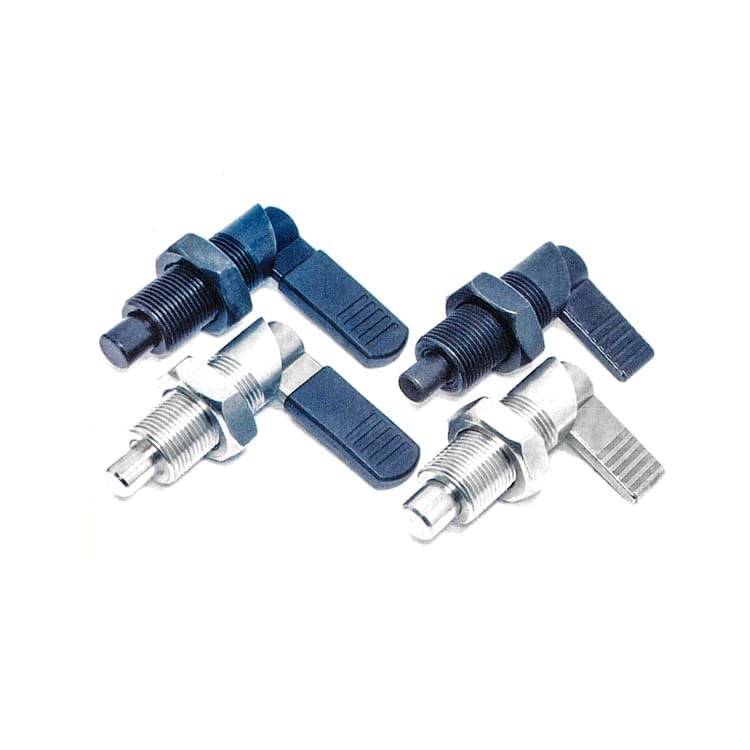
Back in October 2024 I got pulled into a fixturing problem at an automated welding cell builder. Their rotary tables were shifting mid-cycle and they were scrapping parts by the bin. Catalog M12 indexing plungers, stainless pins, the usual setup. The welding robot was throwing roughly 1,200 N of lateral load into each index position and the pins were taking a permanent set because there was a 0.3mm tolerance gap between the pin and the receiving bushing. Once a pin bends even a few thou, you’re done — it’ll bind on retraction every cycle after that.
Their stopgap was machining one-off 4140 pins in-house at $142 a unit, which is the kind of number you only see when a CNC supervisor is doing favors for a desperate engineer. That wasn’t sustainable.
It took three weeks of RFQ ping-pong with spring-loaded device (SLD) shops before we landed on a custom plunger that actually held up.
If you’re reading this you know what an indexing plunger is, so I’ll skip the definitions. What this guide is actually about: when catalog parts fail, how to spec the tolerances you actually need, and how to source custom units without getting buried in tooling costs and lead times.
Who This Is For (And Who Should Leave)
This is for: Mechanical design engineers, manufacturing engineers, and procurement specialists buying custom indexing plungers in volumes of 50 to 5,000 units for OEMs, jigs, or high-cycle fixtures.
This is NOT for: Hobbyists replacing a broken pin on a lat pulldown machine, or buyers who can get away with a $9 McMaster-Carr off-the-shelf part.
My Methodology: When Standard Catalog Parts Stop Working
Before you fire off an RFQ you need a quantitative decision rule. Most buyers jump straight to “fully custom” when a simple “modified standard” would save them 80% on tooling. Here’s the framework I use:
- The ~$300 surcharge threshold. If a catalog supplier offers a “modify a stock part” option (custom thread lengths, unground oversize pins), the setup surcharge is usually somewhere in the $150–$300 range. If your volume is under 250 units, pay the surcharge. Don’t tool up a fully custom part.
- The 500-unit tipping point. At 500+ units, the $15–$25 per-piece premium on a modified standard eclipses the $1,500–$2,500 amortized tooling cost of a fully custom run from a dedicated SLD shop.
- What actually justifies going fully custom: non-standard threads (metric fine M12x1.0 instead of coarse), oversized pin diameters, corrosive environments needing exotic plating (which throws off standard thread tolerances), or a specific side-load requirement that needs heat-treated 17-4 PH.
Anatomy of a Plunger Spec (The Dimensions That Actually Matter)
The moment you deviate from a catalog part you have to nail the tolerances. Leave them blank and the manufacturer will default to ISO 2768-m, which will quietly destroy you in precision fixturing.
| Dimension | Typical Range | Critical Tolerance Class | Cost Impact of Tightening |
|---|---|---|---|
| Pin Outer Diameter (OD) | 4mm – 25mm | h7 or h9 (undersized for clearance) | High. Precision grinding adds 15-20% to piece price. |
| Thread Class | M6 – M24 | 2A (Inch) / 6g (Metric) | Medium. Going to 3A/4g requires thread grinding. |
| Stroke/Travel Length | 4mm – 20mm | ± 0.5mm | Low. Easily adjusted via spring length. |
| Pin Engagement Depth | 3mm – 15mm | +0.2mm / -0.0mm | High. Too deep bottoms out; too shallow causes shear failure. |
| Nose Geometry | Flat, Round, Chamfer | 15° taper vs straight | Low. Tapered (e.g., 15°) prevents binding during retraction. |
6 Sourcing Paths & Manufacturer Case Studies
Six distinct routes for sourcing custom and modified indexing plungers, pulled from my actual procurement records. Different applications, totally different sourcing strategies.
1. The “Modified Standard” Route: Carr Lane
I needed a hyper-precise pin OD for a custom aerospace jig. First instinct was a local machine shop turning the plungers from scratch — they quoted $65 each at 100 units.
Then I remembered Carr Lane sells a “modified standard” option. Instead of buying a finished pin you order their Straight Index Plungers with a slightly oversize, unground OD. We bought the standard assemblies at $28 each and handed them to our local grinder, who brought the pins down to our +0.000 / -0.005mm spec for $8 a piece.
The takeaway: You don’t always need the manufacturer to do the custom work. Buying a manufacturer’s “machinable blank” end and finishing it locally cut lead time from six weeks to eight days.
2. The High-Volume Configurator: Misumi
Packaging machinery line in 2025, 800 plungers, weird combo: M10x1.0 fine thread, 12mm stroke, extended locking pin.
Side-by-side RFQ between McMaster-Carr and Misumi. McMaster had nothing off-the-shelf, and their custom desk took four days to decline the RFQ. Misumi lets you configure L length, thread pitch, surface treatment right on the platform — and it’s not really “custom machining” in the traditional sense, it’s pre-engineered modular components.
We spec’d a 1.4305 (AISI 303 equivalent) hardened pin with electroless nickel plating. Then we got bit. The EN added roughly 0.015mm to the pitch diameter of the fine threads, making them dangerously tight in our tapped holes. We ended up chasing every receiving hole with an oversized tap on the assembly floor. The configurator is fast, but tolerance stack-up on plated fine threads is a known gotcha — watch for it.
3. The Aerospace/Specialty Custom: Vlier
Automation client needed plungers to index a medical device chassis inside a wash-down environment. Catalog stainless wasn’t going to cut it. We needed DFARS-compliant materials and documented spring force curves.
Looking at Vlier’s quote, the cost driver wasn’t the machining — it was the paperwork. A standard Vlier steel indexing plunger is roughly $12–$18. Our requirements (higher AQL inspection plans, full material certs, a custom 360° locking patch instead of their standard pellet) drove it to $74 per unit at an MOQ of 250.
If your industry requires traceability, bake roughly a 400% premium into your BOM for testing and certs. That’s the actual number, and it doesn’t go down at volume nearly as much as you’d hope.
4. The Flange-Mount Alternative: Halder
Here’s something most designers miss: threaded custom plungers often fail because operators screw them in to varying depths, which silently changes pin engagement and spring preload from station to station.
I worked with Halder on custom “Plate Mount” (flange-mounted) retractable spring plungers. Two SHCS into a flat flange, done. Installation depth is no longer a variable. If you’re constantly fighting Z-axis tolerance stack-up on sheet metal applications in the 10–20 N positioning range, stop customizing threaded plungers — switch to flange mount.
5. The Cheap Overseas Clone: AliExpress “YK233”
Painful one. A junior buyer on my team tried to dodge a 7-week domestic lead time by ordering 400 custom-dimensioned YK233-style L-handle plungers off Alibaba. Specs matched the drawing. $4.10 each.
The dimensions were fine. The failure mode was the spring chamber. In wet cutting cycles on a CNC rotary table, high-pressure coolant bypassed the pull-ring housing and hydro-locked the internal spring. The plungers wouldn’t retract. We ran an 18% reject rate on the machined parts because operators couldn’t fully seat the fixture, and we scrapped all 400 units and bought sealed, O-ring-protected plungers domestically.
Never buy unsealed overseas clones for fluid environments. That’s not a guideline, that’s a rule.
6. The Domestic CNC Job Shop
I asked the lead programmer at our local Ohio job shop why his quote for 50 custom plungers was $95 each when the raw material is pennies.
“It’s the assembly, not the turning. I can turn the threaded body and the pin on my Swiss lathe in 45 seconds. But I’m buying the compression springs from MW Components, hand-assembling pin, spring, knob, and then peening or roll-crimping the housing to trap the pin. If you want a custom thread, I’m your guy. If you want a custom spring force, go to a dedicated plunger manufacturer.”
That’s the cleanest summary I’ve heard. Local job shops are great for custom external geometry — weird threads, custom knob shapes. The internal mechanical assembly is where they hemorrhage time.
Spring Force: The Spec Engineers Get Wrong Most Often
If there’s one section you bookmark, make it this one. Engineers consistently over-spec spring force because they assume a stiffer spring will prevent the pin from shearing under a heavy side load.
This is a fundamental misunderstanding of physics. The spring force does NOT resist shear. The solid metal body of the pin and bushing resists shear. The spring’s only job is to push the pin into the detent and keep it there despite vibration.
How to Calculate Required Holding Force
To calculate the initial and final spring pressure you need, evaluate operator ergonomics and vibration.
- Positioning only, no heavy vibration: 10 N – 20 N is plenty.
- Heavy vibration environment: >50 N.
If you spec a 100 N spring force, the operator has to pull with roughly 22 lbs of force to disengage the pin. Operator fatigue skyrockets, and within a week they’re using hammers or pliers to yank the knob and destroying the mechanism. If vibration is genuinely that severe, don’t increase spring force — switch to a locking index plunger with a cam mechanism that mechanically holds the pin out.
Shear Strength Failure Math
If your pin is shearing, you need a thicker pin or a different material. Not a stronger spring.
When you calculate shear strength, you have to account for yield limit ($R_e$), not tensile strength ($R_m$).
- Formula: Approximately 80% of the bolt’s tensile strength is assumed for shear strength ($S = d^2 \times \pi / 4$; $\tau_a = 0.8 \times R_m$).
- Reality check: If you calculate against $R_m$, the pin won’t snap, but it will permanently bend. To ensure proper function without bending you calculate maximum permissible flexural strength against the yield limit ($R_e$). An AISI 303 stainless pin has an $R_e$ around 580 N/mm². If there’s any meaningful gap between the plunger and the hole, the pin acts as a flexure rod clamped on one end, and bending deformation becomes your primary failure mode long before shear does.
That’s exactly what was happening to the welding cell I opened this article with. The pins weren’t shearing. They were bending a few thou per cycle and the operators didn’t notice until retraction force tripled.
Material and Plating Decisions That Survive the Field
“Just make it all 303 stainless” is a lazy spec that causes galling.
| Material Component | Best For | The “Gotcha” (Mistakes to Avoid) |
|---|---|---|
| Pin: 17-4 PH Stainless | High side loads, heavy wear | Hardened pins wear out the receiving holes faster. Your bushing must be harder than the pin, or you’ll oval out your fixture. |
| Pin/Body: 303 SS into 303 SS | Food grade, medical | Galling. If you thread a 303 SS body into a tapped 303 SS fixture without a thread-locking patch or anti-seize, it will cold-weld permanently. Use a brass body or dissimilar stainless. |
| Plating: Electroless Nickel | Corrosion resistance on carbon steel | Dimensional buildup. EN adds 0.005mm – 0.012mm per surface. If you specify an h7 pin tolerance, plate after grinding, or you’ll be out of spec. |
| Knob: Thermoplastic (PA 6) | Standard ergonomics | Degrades rapidly under UV light or aggressive cutting fluids. For harsh environments, spec a knurled stainless or aluminum knob. |
Real Data / Cost Breakdown
Actual financial numbers from my 2025 procurement records, normalized to a 500-unit batch.
| Supplier Type | Tooling/NRE | Unit Cost (500 qty) | Lead Time | Best Use Case |
|---|---|---|---|---|
| Catalog Standard (e.g., Kipp, Elesa) | $0 | $12.50 | 1-2 Days | Prototyping, low-stress jigs. |
| Modified Standard (e.g., Carr Lane) | $200 (Setup) | $28.00 | 2-3 Weeks | Custom thread lengths or unground pins. |
| Configurable (e.g., Misumi) | $0 | $18.50 | 8-15 Days | Need weird metric sizes but standard materials. |
| Custom Job Shop (Domestic) | $450 (Programming) | $65.00 | 4-6 Weeks | Urgent geometric changes, custom knobs. |
| Specialty Custom (e.g., Vlier) | $1,200 (Testing/Eng) | $74.00 | 8-10 Weeks | Aerospace, DFARS, custom locking patches. |
The Spec Sheet Template Manufacturers Actually Want
Stop writing paragraphs in your RFQ emails. Quoting engineers hate it. Copy this Markdown template into your RFQ — I’ve refined it to eliminate the five clarification questions vendors ask most often.
5 Spec Mistakes That Cause Field Failures
Mistake 1: Ignoring Thread Pitch in Thin Walls
- Symptom: The plunger wiggles loose during operation, or the fixture threads strip.
- Root cause: Coarse threads (1/2-13 or M12x1.75) in thin-walled sheet metal fixtures. Not enough threads engaged.
- Prevention: Spec fine thread (M12x1.0 or M12x1.5), or use a flange-mount plunger when mounting into material thinner than 6mm.
Mistake 2: Over-Cycling the Internal Spring
- Symptom: Pin fails to push out fully after three months.
- Root cause: Spring fatigue. Most catalog plungers are rated for a specific cycle life, and running a heavy-duty plunger at its absolute maximum compression continuously will permanently deform the spring.
- Prevention: Design the fixture so the plunger operates at its working height (partially squeezed), not its maximum compression (bottomed out).
Mistake 3: Poor Bushing Alignment
- Symptom: Operator has to forcefully yank the knob and it snaps off.
- Root cause: The receiving hole is perfectly cylindrical, but fixture alignment is slightly off, creating a side load on the pin while the operator is trying to pull it.
- Prevention: 15° taper on the pin nose with a matching tapered bushing. Drastically reduces binding during retraction.
Mistake 4: The Coolant Trap
- Symptom: Plunger rusts from the inside out or hydro-locks.
- Root cause: Open-backed or unsealed standard plunger in a machining center.
- Prevention: Spec “Sealed Spring Plungers” with internal O-rings.
Mistake 5: Neglecting the Thread Locking Element
- Symptom: The plunger gradually backs out from vibration, reducing pin engagement until the part shears.
- Root cause: Metal-to-metal threads with no locking agent.
- Prevention: Add “360° Nylon Thread-Locking Patch” to the RFQ. Don’t rely on operators applying liquid Loctite on the assembly floor. They will forget.
FAQ
1. What’s the minimum order quantity (MOQ) for custom indexing plungers?
For modified standards (custom thread lengths and so on), MOQs are often as low as 10–50 units. For fully custom units that need new spring winding or custom bodies, expect 250–500 to offset the CNC setup time.
2. How long does a custom indexing plunger take to manufacture?
Configurator (Misumi): 8–15 days. Modified standard blank: 2–3 weeks. Fully custom from a specialized SLD manufacturer: typically 6–8 weeks including first-article inspection. That FAI window is where most schedules slip — I’ve watched programs eat two extra weeks because the FAI samples came back with a thread callout the vendor read differently than we did, and nobody had specified the gauge class on the print. Build the buffer in.
3. Can I modify a standard indexing plunger instead of going fully custom?
Yes, and you usually should. Buy units with unground ODs for custom pin diameters, or buy them with overly long threads and face them down in a lathe. Avoids $1,500+ custom tooling charges.
4. How do I calculate the right spring force for my application?
Don’t use spring force to counteract shear load. Spring force only overcomes friction and vibration. 10–20 N for light positioning. >50 N for heavy vibration.
5. What’s the difference between a locking and non-locking indexing plunger?
Non-locking (return type) snaps the pin back into the hole the instant you release the knob. Locking has a cam — pull and twist the knob 90°, it stays retracted so you can use both hands to swap parts.
6. What thread sizes are available for custom plungers?
Anything a shop can cut. Staying within M6 to M24 (or 1/4-20 to 1″-8) keeps costs low.